§1 Problem Architecture
Foundational diagnosis: organizations lack decision capture infrastructure. Three empirical validations. Cybernetic derivation.
§1 Problem Architecture
v2.0.0 · Locked · L1 · March 19, 2026
Purpose
This section establishes the foundational problem that DLP addresses: organizations produce decisions but do not capture the reasoning, authority, evidence, and constraints that produced them. Three independent empirical research programs validate this failure from different directions. The Conant-Ashby theorem and Ashby's Law of Requisite Variety establish why the failure is structural and what infrastructure is required to correct it.
Foundation
What DLP Is and What Problem It Solves
The Decision Lineage Protocol (DLP) is a behavioral specification for organizational decision capture. It defines the primitives, invariants, and truth classifications that any substrate must implement to construct and maintain an Organizational World Model (OWM) — a queryable representation of who decided what, based on what evidence, under what authority. DLP records organizational decisions at the moment of action with authority, evidence, constraints, and rationale attached, making the reasoning behind organizational action transparent and recoverable.
DLP exists because the infrastructure for this does not. Organizations produce documents about decisions — board resolutions, strategy memos, compliance reports, approval workflows. These documents record conclusions. They do not record how decisions were made, what information was available, which alternatives were considered, what constraints were active, or who had authority to decide. The decision itself — the convergence of evidence, authority, and intent into a binding selection — is never captured. What survives is the artifact: a document designed to communicate a conclusion to an audience, not to preserve the reasoning that produced it.
This is not a failure of individual diligence. It is a failure of infrastructure. Existing governance frameworks (COSO, COBIT, ISO 31000) specify what should be captured but provide no mechanism for capturing it at decision time. Audit depends on reconstructing decisions from artifacts never designed to preserve rationale — a forensic exercise that can detect inconsistency but cannot establish ground truth. Context evaporates: six months after a decision, participants remember differently; twelve months later, key actors have left; twenty-four months later, the decision exists only as an artifact with no recoverable process. Organizational amnesia is structural, not incidental.
The temporal asymmetry is fundamental. The moment of decision is characterized by active constraints, available information, considered alternatives, and contextual pressures. None of these survive the transition to documentation. What gets written down is the output — the choice made — stripped of the process that produced it. Retrospective documentation cannot recover this. Memory research is unambiguous: post-hoc rationalization is the norm, not the exception. Even with perfect intentions, participants cannot accurately reconstruct their reasoning after the fact. Decision capture must therefore be prospective — the substrate must be present at the moment of decision, recording authority, context, constraints, and rationale as the decision occurs.
DECISION LINEAGE PROTOCOL
┌───────────────────────────────────────────────────┐
│ │
│ DECISIONS │
│ Intent + Evidence + Authority + Constraints │
│ │
└──────────────────────┬────────────────────────────┘
│
▼
┌───────────────────────────────────────────────────┐
│ │
│ SUBSTRATE │
│ State(t) → [Trigger + Action] → State(t+1) │
│ │
│ Nine primitives provide governance context │
│ Truth types classify epistemic status │
│ Behavioral invariants enforce integrity │
│ │
└──────────────────────┬────────────────────────────┘
│
▼
┌───────────────────────────────────────────────────┐
│ │
│ ORGANIZATIONAL WORLD MODEL │
│ Accumulated state transformations with lineage │
│ Queryable decision history │
│ Deviation measurement against intent │
│ Forward projection over primitive state │
│ │
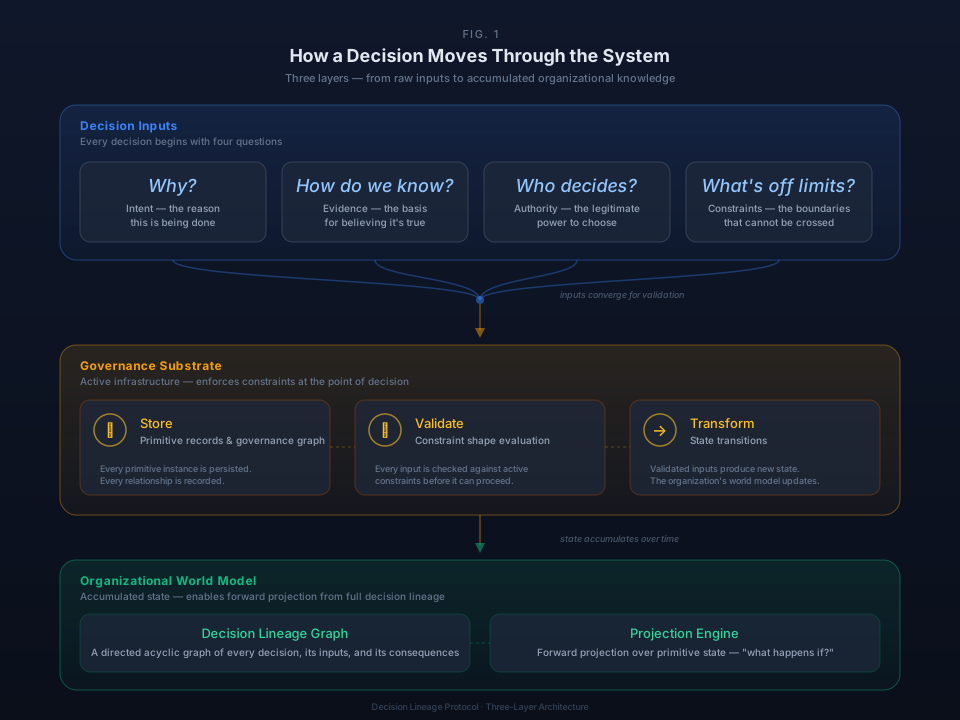
└───────────────────────────────────────────────────┘Figure 1.1: Architecture shape. Decisions enter the substrate with primitive context — intent, evidence, authority, constraints. The substrate records each decision as a state transformation with full lineage. The accumulated record becomes the organizational world model: a queryable representation of who decided what, based on what evidence, under what authority, subject to what constraints, and how outcomes compared to intent.
Empirical Grounding: Three Independent Validations
Three independent research programs — none aware of each other, none aware of DLP — have validated the structural diagnosis from different directions. Each identifies a dimension of the same underlying failure: organizations lack infrastructure for truth-accountable decision-making.
Truth-indifference is structural
Frankfurt (2005) drew the foundational distinction: bullshit is not lying. The liar engages with truth — the lie is parasitic on accurate knowledge. The bullshitter is indifferent to whether a statement is true or false. What matters is whether it achieves the desired effect: impressing an audience, securing approval, maintaining appearances. Frankfurt's conclusion: bullshit is a greater threat to truth than lying, because it corrodes the very concept that truth is a relevant category for communication.
Ferreira et al. (2022) operationalized this for organizations. The Organizational Bullshit Perception Scale (OBPS), validated across 448 employees, identifies three independent dimensions of organizational truth-indifference:
| OBPS Factor | Organizational Failure | DLP Primitive Response |
|---|---|---|
| Regard for truth | Statements produced without regard for evidence; impressive language substitutes for substantiated claims | Evidence primitive (§4) + truth type system (§6): every state transformation declares its evidentiary basis as Authoritative, Declared, or Derived |
| The Boss | Hierarchical authority substitutes for truth; the source of a statement replaces its evidentiary basis | Authority primitive (§4): every decision traces to its authorization source through explicit, recorded delegation chains |
| Bullshit language | Jargon obscures rather than reveals; organizational vocabulary serves impression management, not communication | Nine primitives named in organizational language: Intent, Commitment, Capacity, Work, Evidence, Decision, Authority, Account, Constraint — deliberately small, concrete, resistant to abstraction drift |
Table 1.2.1: OBPS three-factor structure mapped to DLP primitive responses. Each empirically identified dimension of organizational truth-indifference maps to a specific substrate mechanism.
The finding is not that organizations occasionally mislead. The finding is that truth-indifference is structural — embedded in how organizations communicate by default when no infrastructure connects statements to evidence, outcomes to intentions, or authority to accountability. This is why cultural interventions ("be more honest," "speak truth to power," "cut the jargon") consistently fail. They address symptoms while the structure continues to produce the pathology.
AI amplifies truth-indifference
McCarthy et al. (2024) identified botshit: the organizational phenomenon that occurs when humans uncritically propagate AI-generated content into decision streams. The distinction from AI hallucination matters. Hallucination is a technical phenomenon — the model generates incorrect output. Botshit is an organizational phenomenon — humans propagate AI-generated content without verification, and that content enters decisions as if it were validated.
McCarthy et al. identify four modes of human-AI interaction: authenticated (human verifies against independent evidence), autonomous (AI operates independently), automated (structured inputs and outputs), and augmented (human uses AI output without systematic verification). The augmented mode is where botshit proliferates. The human adds credibility — their authority, their organizational position, their implicit endorsement — to content they have not verified. The AI's truth-indifference is laundered through human authority.
The architectural implication extends to the dominant AI agent paradigm: deploying agents to search Slack, email, documents, and databases to "find context" for decisions. The documents being searched were never designed to preserve decision rationale. Email threads contain positioning, not reasoning. Meeting notes reflect what participants wanted recorded, not what was discussed. Strategy documents are retrospective narratives, not decision logs. Sending agents to retrieve context from unstructured organizational communications inherits the truth-indifference embedded in those communications. The contamination is at the source.
The substrate response is architecturally different: capture decision context at the moment of action — with explicit evidence, authority, and constraints — rather than reconstructing it later from contaminated archives. This is the prospective capture thesis: the substrate must be present when decisions occur, not deployed after the fact to search for what decisions left behind.
Human reliability varies
Littrell (2025) developed the Corporate Bullshit Receptivity Scale (CBSR), validated across four studies (N=1,018). The critical finding: corporate bullshit receptivity is the strongest negative predictor of work-related decision-making quality. Individuals high in CBSR rate vacuous corporate statements as profound, show lower analytical thinking scores, and make worse decisions in scenarios requiring evaluation of evidence quality.
This breaks "human-in-the-loop" as a structural governance guarantee. The standard argument — AI may hallucinate, but human reviewers will catch errors — is empirically false for a measurable portion of the workforce. High-CBSR individuals do not filter truth-indifference; they amplify it. Adding reviewers who are themselves BS-receptive adds governance layers without adding verification. More loops does not mean better loops.
The combination of McCarthy's botshit and Littrell's CBSR creates a compounding feedback loop: AI generates truth-indifferent content → high-CBSR humans accept it uncritically → the content enters organizational decision streams with human endorsement → other humans treat the endorsed content as verified → decisions are made on unverified foundations.
The Cybernetic Diagnosis
Conant and Ashby (1970) proved that every good regulator of a system must be a model of that system. This is not a design recommendation — it is a theorem with formal proof. A regulatory system that does not contain a model of the system it regulates cannot achieve effective control. Its responses will be inappropriate because they are not informed by the actual state of the system being regulated.
Organizations are self-regulating systems. They make decisions about resource allocation, strategy, personnel, compliance, and risk — all forms of regulation. The Conant-Ashby theorem requires that effective organizational regulation contain a model of organizational decision state: who decided what, based on what evidence, under what constraints, with what authority, and how outcomes compared to intent.
Most organizations do not have this model. They have fragments: accounting systems that model financial state, CRM systems that model customer relationships, project management tools that model work allocation. But no integrated model of organizational decision state exists — no infrastructure that represents who decided what, based on what evidence, under what constraints, with what authority, and how the outcome compared to the intent. The organization can tell you its financial position, its customer pipeline, its project status. It cannot tell you how it arrived at any of these, or whether the decisions that produced them were authorized, rational, and traceable.
The three empirical programs converge on a single diagnosis through the Conant-Ashby lens:
| Research Program | Finding | Conant-Ashby Interpretation |
|---|---|---|
| OBPS (Ferreira et al. 2022) | Organizations produce truth-indifferent communications across three structural dimensions | The regulator has no model — outputs are unconstrained by organizational reality |
| Botshit (McCarthy et al. 2024) | AI amplifies truth-indifference when humans adopt AI output without verification | The model deficit compounds through AI — even the search for context becomes truth-indifferent |
| CBSR (Littrell 2025) | Individual humans vary measurably in their ability to detect corporate bullshit | The human component of the regulatory loop has variable fidelity — some humans amplify rather than filter |
Table 1.3.1: Three-study convergence through the Conant-Ashby lens.
The unifying diagnosis: organizations lack the infrastructure to maintain world models of their own decision processes. Without this infrastructure, truth-indifference is the structural default (OBPS), AI amplifies it (Botshit), and human governance cannot reliably correct it (CBSR).
Ashby's Law of Requisite Variety (1956) sharpens the diagnosis: V(R) ≥ V(D). The variety of the regulator must equal or exceed the variety of the disturbances it faces. An organization facing complex, multi-stakeholder, multi-constraint decisions needs governance infrastructure with enough variety to represent those decisions accurately.
Current governance infrastructure — compliance checklists, approval workflows, audit trails — lacks the variety to represent actual organizational decisions. A compliance checklist captures whether a step was completed, not what evidence informed the decision at that step. An approval workflow records who signed, not whether the signer had the authority, information, and context to make a sound judgment. An audit trail preserves a sequence of actions, not the rationale connecting them. The result is a variety gap: decisions are complex, governance infrastructure is simple, and the gap is filled with truth-indifferent artifacts that create the appearance of governance without the substance.
The nine DLP primitives (§4) are the requisite variety claim for organizational decision governance. Nine independent governance dimensions — Intent, Commitment, Capacity, Work, Evidence, Decision, Authority, Account, Constraint — each answering a question that no other primitive addresses. The claim of irreducibility is a claim about requisite variety: fewer primitives would leave some decision contexts unrepresentable; more would be reducible to combinations of existing ones. §4.2 validates this claim through removal, merger, and sufficiency testing. §8 formalizes the full control-theoretic derivation, tracing the chain from Conant-Ashby through Ashby's Law and Beer's Viable System Model to the state prediction isomorphism that makes the substrate an organizational world model.
Governance
This section is owned by Cam (founder, GrytLabs). Changes to problem diagnosis or empirical grounding require evidence review. The convergence of three independent research programs means claims about organizational failure are research-grounded, not aspirational.
Substance
§1.1 Problem Definition and Infrastructure Gap
The Decision Lineage Protocol exists to address a structural infrastructure failure: organizations lack mechanisms to capture decision reasoning at the moment of action. This gap produces three cascading failures:
-
Rationality amnesia: The reasoning, evidence, alternatives, and constraints that produced a decision cannot be recovered after the fact. Post-hoc reconstruction depends on participant memory, which is systematically unreliable. Organizations cannot accurately explain their own decisions.
-
Authority obscurity: Decisions occur without clear recording of who had the authority to decide. Approval workflows record that someone signed; they do not record whether that person had delegated authority to decide on that issue under those constraints.
-
Accountability vacuity: Audit trails show what happened; they do not show the reasoning that produced it. Compliance checking verifies that steps were completed, not that steps were grounded in adequate evidence and exercised within proper authority bounds.
The substrate addresses this infrastructure gap by requiring prospective capture — the substrate is present at the moment of decision, recording intent, evidence, authority, and constraints as the decision occurs, not after it.
§1.2 Three-Program Empirical Convergence
§1.2.1 Organizational Bullshit Perception Scale (Ferreira et al. 2022)
The OBPS identifies three independent, empirically validated dimensions of organizational truth-indifference:
-
Regard for truth: Organizations produce statements without systematic grounding in evidence. Impressive language substitutes for substantiated claims. The substrate responds by making Evidence (§4) a primitive that every decision must engage with, classified by truth type (§6).
-
The Boss: Hierarchical authority substitutes for truth. The source of a statement replaces verification as the criterion for acceptance. The substrate responds by making Authority (§4) explicit and traceable through delegation chains, making authority visible and reviewable.
-
Bullshit language: Organizational vocabulary serves impression management rather than clear communication. Jargon obscures meaning. The substrate responds by deliberately bounding the governance vocabulary to nine named primitives: Intent, Commitment, Capacity, Work, Evidence, Decision, Authority, Account, Constraint — each with defined composition rules, resistant to abstraction drift.
§1.2.2 Botshit: AI Amplifying Truth-Indifference (McCarthy et al. 2024)
McCarthy et al. identify a specific organizational failure: humans uncritically propagate AI-generated content into decision streams without systematic verification. The distinction from AI hallucination is organizational, not technical: the human adds credibility (their authority, their organizational role) to content they have not independently verified. The AI's truth-indifference is laundered through human authority.
The substrate response is architectural asymmetry: all AI-generated content enters as Derived (§6, truth type) — marked as machine-inference — and requires explicit human promotion to Declared or Authoritative status. No architectural path exists for AI output to bypass human epistemic judgment and enter as Authoritative. The substrate distinguishes Derived (machine inference) from Declared (human assertion) from Authoritative (verified fact), making the epistemic status of every decision input visible.
§1.2.3 Corporate Bullshit Receptivity (Littrell 2025)
Littrell's CBSR breaks the assumption that "human-in-the-loop" provides a structural governance guarantee. Individual humans vary measurably in their ability to detect corporate bullshit. High-CBSR individuals do not filter truth-indifference; they amplify it. The implication: governance structures cannot depend on the capacity of particular humans to detect falsehood.
The substrate response: structural requirements independent of individual cognitive tendencies. Behavioral invariants (§5) impose the same evidence declaration, authority tracing, and constraint identification regardless of the actor's BS receptivity. B8 ensures that governance signals route to an authority on the governance chain (someone with responsibility), not to the nearest available human. The governance structure does not depend on any individual's capacity to detect truth-indifference.
§1.3 Cybernetic Derivation: Conant-Ashby and Ashby's Law
§1.3.1 The Conant-Ashby Theorem
Conant and Ashby (1970) proved that every good regulator of a system must contain a model of that system. This is a mathematical theorem, not a design recommendation. A regulatory system without a model of the system it regulates cannot achieve effective control because its responses will not be informed by the actual state of the regulated system.
Applied to organizations: organizations are self-regulating systems making decisions about resource allocation, strategy, personnel, and risk. Effective organizational regulation requires a model of organizational decision state — who decided what, based on what evidence, under what constraints, with what authority, and how outcomes compared to intent. Most organizations lack this integrated model. They have fragments (financial systems, CRM, project management) but no unified representation of organizational decision state.
§1.3.2 Ashby's Law of Requisite Variety
Ashby's Law: V(R) ≥ V(D). The variety of the regulator must equal or exceed the variety of the disturbances it faces. Applied to organizational governance: the governance infrastructure must have enough independent dimensions to represent the variety of decisions the organization makes.
Current governance infrastructure is dimensionally sparse:
- Compliance checklists: Single dimension (step completed/not completed). Does not capture evidence quality, authority verification, or constraint satisfaction.
- Approval workflows: Two dimensions (who signed, what they signed). Does not capture authority legitimacy, decision context, or evidence basis.
- Audit trails: Sequence of actions. Does not capture rationale, authority chain, or constraint engagement.
The nine DLP primitives (Intent, Commitment, Capacity, Work, Evidence, Decision, Authority, Account, Constraint) provide the irreducible minimum governance variety. Nine independent dimensions, each answering a governance question no other primitive addresses. Removal testing (§4.2) confirms that losing any primitive creates an unrepresentable decision context. The variety gap closes through nine-dimensional governance, not through better training or more oversight.
§1.4 The DLP Response: Substrate as Infrastructure
The substrate does not address truth-indifference through cultural change, training programs, or AI detection tools. It makes truth-indifference structurally expensive by requiring every decision to engage with evidence, authority, and constraints at the moment of action.
The mechanism is analogous to double-entry bookkeeping. Double-entry does not prevent financial fraud. It makes fraud structurally expensive by requiring every transaction to balance across two accounts — creating a structural engagement with financial reality at every entry point. The substrate creates the same structural engagement with decision reality: every state transformation must declare its evidence, trace its authority, identify its constraints, and link to the account context against which it is evaluated. You can still make a bad decision. You cannot make an invisible one.
| Empirical Failure | Substrate Mechanism |
|---|---|
| Truth-indifference (Frankfurt; Ferreira F1) | Evidence primitive + truth type system (§6). Every decision declares its evidentiary basis as Authoritative, Declared, or Derived. The decision-maker must declare their relationship to evidence — truth-indifferent state transformations cannot pass through the substrate without that declaration. |
| Authority substitutes for truth (Ferreira F2) | Authority primitive + behavioral invariant B5 (§5). Every decision traces to its authorization source through a delegation chain terminating at a root authority. "The boss said so" is visible as a Declared evidence type — recorded and auditable, but not Authoritative until independently substantiated. |
| Jargon obscures (Ferreira F3) | Nine primitives in organizational language. The governance vocabulary is deliberately small, concrete, and semantically bounded (§4). Each primitive answers one governance question. The vocabulary resists abstraction drift because the primitive set is closed and irreducible. |
| AI amplifies truth-indifference (McCarthy) | Truth type system (§6): all AI-generated content enters as Derived and requires explicit human promotion to Declared or Authoritative. No architectural path exists for AI output to bypass staging. The substrate captures structured context at decision time rather than retrieving unstructured content from contaminated archives. |
| Variable human reliability (Littrell) | Structural requirements independent of individual cognitive tendencies. The substrate imposes the same evidence declaration, authority tracing, and constraint identification regardless of the actor's BS receptivity. Behavioral invariant B8 (§5) ensures that governance signals — deviation alerts, constraint violations, flagged anomalies — route to an authority on the governance chain, not to the nearest available human. The structure does not depend on any individual's capacity to detect truth-indifference. |
Table 1.4.1: Empirical failure → substrate mechanism. Each independently validated organizational failure maps to a specific infrastructure response.
The remainder of this document specifies the mechanism. §4 defines the nine irreducible primitives and their composition mechanics. §5 specifies the ten behavioral invariants that constrain valid state transformations. §6 formalizes the truth type system that classifies the epistemic status of every governed object. §7 defines the Minimum Viable Record — what must be captured for each primitive instance to be auditable. Together, they constitute the decision infrastructure that the empirical evidence shows does not exist and that the cybernetic diagnosis shows must.
The architecture is not a compliance tool. It is a world model — an infrastructure for organizational self-knowledge. §3 specifies the world model architecture. §8 formalizes the control-theoretic derivation that connects the problem identified here to the mechanism specified there.
Boundaries
This section establishes the problem and empirical grounding. It does NOT specify: the substrate mechanism (§4–§7), the world model architecture (§3 and §8), the behavioral invariants that enforce the mechanism (§5), or implementation details (§26+). The diagnosis of truth-indifference is research-grounded; the response is architecturally specified in subsequent sections.
Positions
Locked. Problem diagnosis grounded in three independent empirical programs. Cybernetic derivation from Conant-Ashby and Ashby's Law. Infrastructure response: nine primitives as requisite variety claim. All substrate mechanisms map empirical failures to specific infrastructure responses.
Lineage
v1.0.0 (February 25, 2026): Base lock. Three-program empirical convergence. Conant-Ashby and Ashby's Law derivation. v2.0.0 (March 19, 2026): Locked as foundational specification. No changes to problem diagnosis or empirical grounding. Formatting converted to fspec.
Commitments
SDK implementations MUST implement all nine primitives (Intent, Commitment, Capacity, Work, Evidence, Decision, Authority, Account, Constraint). SDK implementations MUST enforce the behavioral invariants (§5) that constrain primitive relationships. SDK implementations MUST classify evidence by truth type (§6).
Coverage
Problem diagnosis fully specified with research grounding from three independent programs. Cybernetic derivation complete. Infrastructure response maps each empirical failure to a substrate mechanism. Implementation details deferred to §4–§7.
Addressing
Document ID: s01-problem-architecture. Part: I (Foundational Problem). Sections addressable by number (§1.1–§1.4). Cross-references use [s01-problem-architecture.{section-id}] notation.
Attribution
Primary author: Cam (founder, GrytLabs). Research grounding: Frankfurt (2005), Ferreira et al. (2022), McCarthy et al. (2024), Littrell (2025), Conant & Ashby (1970), Ashby (1956). Composition support: Claude (Anthropic).
Situational Frame
This section was composed as the foundational specification for DLP. The three empirical programs were discovered independently and composed into a unified diagnostic framework. The Conant-Ashby/Ashby's Law derivation provides the mathematical grounding for why the problem is structural and why nine-primitive infrastructure is the required response.
Scope Governance
Core namespace: dlp. Problem diagnosis is foundational to all DLP specifications. All subsequent specifications (§2–§9+) build on this diagnosis. The nine primitives named here are the basis for the formal specifications in §4.
Framing
This section frames organizational decision failure as a structural, research-validated problem — not as a moral or cultural issue. The framing determines the design: structural problems require infrastructure responses, not training, policy, or cultural interventions. The section moves from problem diagnosis (§1.1–§1.3) to substrate response (§1.4).
Adaptation
No post-lock adaptations to foundational problem diagnosis. The three-program empirical convergence and Conant-Ashby derivation remain the grounding. Implementation details and response mechanisms are addressed in subsequent sections, which reference this foundation.
Readiness
This section is ready for all uses: specification foundation, implementation guidance, onboarding reference, regulatory documentation. The problem diagnosis is research-grounded and suitable for stakeholder communication. The infrastructure response is architectural and specifiable in subsequent sections.
Meaning Resolution
No meaning resolution for this document.
Perception Surface
No perception surface for this document. This section specifies the problem diagnosed through organizational and academic research; it does not interface with external systems. External organizational events (decisions, actions, data) enter through the substrate specified in §4–§7.
Temporal Governance
No temporal governance for this document. Problem diagnosis does not change with operational time. The three empirical programs and cybernetic derivation are persistent specifications.
Decision Lineage Protocol — Architecture Specification
Master index for the Decision Lineage Protocol architecture specification. Registry of all 31 fspec-format section files in dlp/spec/.
§2 Paradigm Shift
Process accountability vs outcome accountability. Empowerment infrastructure, not surveillance. Cognitive load theory. Psychological safety.